Sorry, you need to enable JavaScript to visit this website.
Skip to main content
Moving House with Your Cat
6 mins read
Cats love sharing your home with you – for them, it’s somewhere familiar and comforting where they can feel safe, secure and relaxed. When you’re moving house with your cat, it’s bound to be disrupting, stressful and disorientating, for both of you! However, there are things you can do to help your cat keep calm during and after the move to help them feel comfortable in their new surroundings. In the build up to the big move, your home will start to feel unsettled for your feline friend; packing boxes, strangers wandering in and out, new scents and the emptying of once-familiar rooms can all add to their anxiety. If your cat is used to staying with some familiar friends of yours or in a cattery, it may be a good idea to have them stay there for a short break to spare them the stress. If you decide on a cattery, book well in advance and make sure all their vaccinations are up to date. Read our article on cat sitting and catteries for more helpful tips and advice. If you’d prefer to keep your cat with you during the move, set aside a quiet room in your old house and leave it untouched until the very last minute. Get them accustomed to that room about a week before you move by placing their bed, litter tray, toys, food and water bowls in there. It will soon feel like their home within a home, and allow them a haven away from the hustle and bustle in the rest of the house! "Once you’ve moved home with your cat you need to give them at least a week to get used to their new surroundings before you let them go outdoors."
Litter Training Kittens and Cats
6 mins read
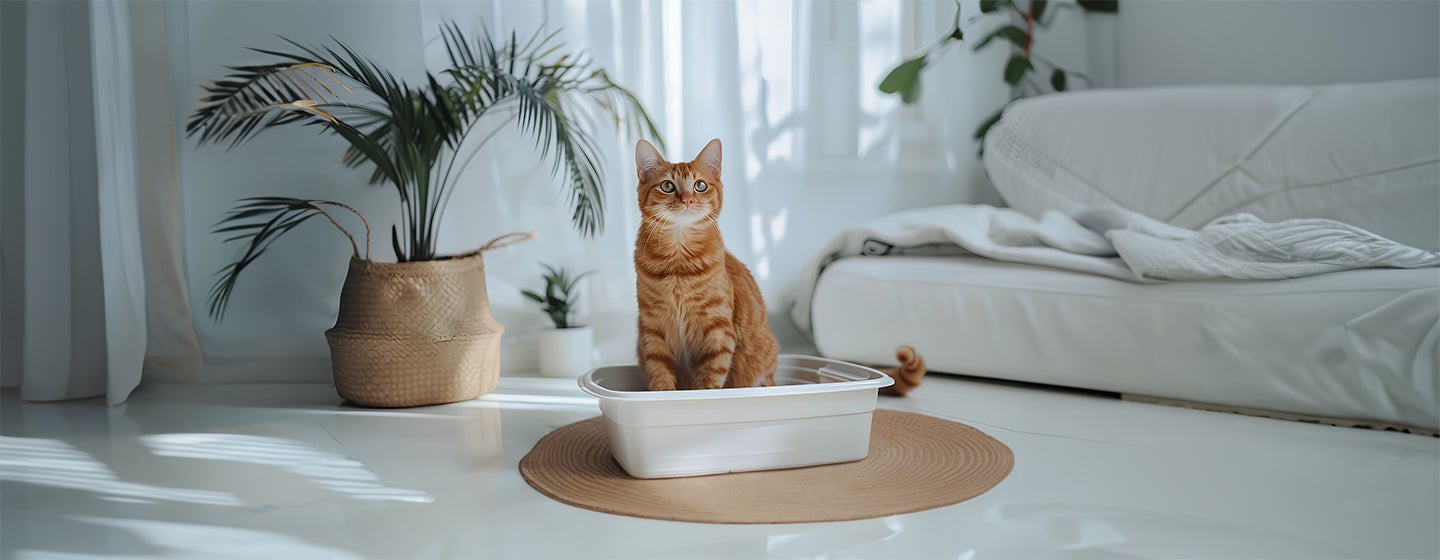
If you have an indoor cat or one with limited access to outside, a litter tray is essential. Litter training kittens and cats is relatively simple and with this helpful guide your furry friend will be using the tray confidently in no time! Your cat’s natural instincts will usually find them wanting to go to the toilet outside, but many cats like to have a litter tray indoors too. It’s usually best to start with cat toilet training from a young age, but older cats can still be taught to use a litter tray. In fact, they may even find it beneficial as their joints are stiffer and they lack the same energy to go outside. If you’re new to litter training kittens or cats, you may be wondering where to start. That’s why we created this guide to tell you everything you need to know, from what you’ll need to get started to how to get your new kitten accustomed to using the tray. Getting the perfect cat litter tray If you’re just starting out litter training kittens, ensure you use a low-sided plastic tray at first for easy access. When they’ve grown a bit, you’ll want to swap to a larger and deeper tray to give them enough room to turn around and prevent kicking up and scattering the litter all over your home.
Kitten Teething Advice
6 mins read
Do kittens teeth? All kittens go through a teething process – it’s a natural part of growing up. But whilst some kittens deal with teething well, others may need a little reassurance from you. Whatever the case, rest assured that teething is completely normal. Keep reading to find out more about the process of kitten teething. When do kittens start teething? Just like humans, kittens do not have visible teeth when they are born. Your kitten’s 26 ‘baby teeth’ only start to appear at around three weeks of age. Once the baby teeth start to break through and pierce the gums you may start to see your kitten behaving differently – for example, they might begin to chew things. Don’t worry, this is completely normal. By about six weeks of age most kittens will have grown all of their ‘milk teeth’ (or ‘baby teeth’). If your kitten hasn’t grown all of their teeth by this stage, don’t worry. Not all kittens’ teeth grow at the same rate. However, if there are a number of teeth missing once your kitten reaches nine or ten weeks, you may want to contact your vet to check everything is okay. At around six months of age most cats should have lost their baby teeth to make way for their adult teeth. As the baby teeth are slowly replaced by 30 adult teeth, this is when the majority of kitten teething issues begin. The new teeth that are beginning to poke through will replace the baby teeth and will be the final set of teeth your cat will have, so it’s particularly important to take care of them. If you find your kitten’s baby teeth on the floor during this time, don't worry – kitten tooth loss a natural part of the growing-up process. Kitten teething symptoms When your kitten is teething, they may be experiencing some discomfort. The most obvious signs of dental discomfort are: • Your cat has started to eat less. If they are chewing slower than usual, or more tentatively, it could be a sign their gums are hurting. It may be a good idea to pay a visit to your vet, just to be on the safe side, particularly if they also lose weight. • Urgency to chew. Another sign that your kitten is teething is excessive chewing. If your cat or kitten is chewing everything in sight including its bed, your furniture and its toys it may be a sign that teething has begun. • Inflamed or sore gums. As their adult teeth erupt, kittens may experience mild gingivitis, which can lead to inflamed gums and bad breath. If this is down to teeth erupting, it will usually resolve itself. • Other signs of dental discomfort are drooling, bleeding gums, and pawing at the mouth. These can also be signs of other dental conditions, so see a vet for a check-up. • Increased irritability. This is most likely due to sore gums and a sign that your kitten is teething.
Health
Introducing Your New Dog to a Cat or an Older Dog
7 mins read
Dogs usually make firm friends easily, and your pup will almost certainly love being around other canine companions. In fact, they’ll probably jump at the chance to play with any animal, including cats. Here is how to introduce your new dog to the other pets in the family. As with any new experience for your pup, it’s important to introduce them to other pets carefully, to give their friendship the best possible start. But oftentimes this is easier said than done. An older dog can get territorial when they’ve stopped being the only four-legged member of the family. And a cat will let you know in no uncertain terms when they’re not happy with the new roommate. So, how to introduce a dog to a cat or a puppy to an older dog without World War III breaking out right in your living room? We’ve broken down the process of introducing a new dog into easy steps. Here is what you can do to help make the experience a smooth transition to family life for the new arrival and keep fellow pet residents calm during those first interactions.
How to Walk Dogs & Puppies on a Lead?
19 mins read
There’s nothing worse than a puppy that won’t stop pulling on the lead. It can be extremely tiring for both you and your pup and can turn a simple walk into a complete nightmare. If your dog is straining at the lead, or your puppy refuses to walk without pulling with all their strength, it means that you are only controlling them with physical restraint, rather than with the training that should keep them happily trotting at your side. Not only that but, as they get older, the physical effort involved in controlling your dog could be overwhelming, especially if your canine friend is one of the larger, stronger breeds. To make life easier for you and your dog, all it takes is a little training and they’ll be overjoyed at the sight of their lead in no time. Keep reading to find out how to leash train a puppy! Why lead training puppies is important Exercise Being able to walk your puppy on a lead provides an opportunity to exercise your dog and keep them healthy while they grow and mature. Mental stimulation Exposing your puppy to new environments is essential to their growth and development, and walking on a lead is essential to exploring many new places. The act of training itself is also great mental stimulation for your dog! Further training Lead training also improves responsiveness to overall obedience training, and it may become easier to teach other commands such as ‘sit’ or ‘stay’ once your puppy has learned to be walked on a lead. What you’ll need before you start puppy lead training A collar or harness Buy a collar or harness that fits your puppy appropriately, never too loose or too tight – you should be able to fit two fingers between the collar and your puppy’s neck. Treats Use treats to reward them for good behaviour on the lead.
Behaviour & Training
How to Stop Aggressive Dog Behaviour
11 mins read
There are many reasons why your dog may be aggressive, and it may require veterinary advice. Read about the causes of aggressive behaviour in dogs here. Your dog has a personality completely unique to them – and like all dogs, they have different moods ranging from joyful to scared. If your dog is behaving aggressively however – either to people or other dogs - you should address it as soon as possible. Aggressive dog behaviour can include: • Aggression to strangers • Aggression to family members • Guarding resources (such as food, treats or toys) • Aggression to other dogs in the household • Aggression to unknown dogs If your dog is showing any signs of aggression, first of all, consult your veterinary surgeon. Your vet will conduct a full examination to see if there is a clinical reason for your dog’s aggression such as pain, discomfort or any other physical cause. If no medical explanation or treatment can be found, the vet can refer you to a professional behaviourist for help. Take a look at your pet insurance policy - some will cover these fees for your added peace of mind. Although taking your dog to see the vet or behaviourist might seem worrying, you should never attempt to treat your dog’s aggression yourself, or ignore it and hope it will go away. If your dog’s aggression is not tackled quickly and appropriately, the problem can escalate and may result in serious injury to yourself and your family, other people or other animals, and even legal issues – and of course, you want to get help for your dog long before it gets this far! This is a problem that is far better - and far easier - tackled straight away. Why is my dog aggressive? All behaviours happen for a reason and occur as a result of the way the dog is feeling – and aggression is no different. A properly qualified and experienced behaviourist will be able to get to the heart of why your dog feels they need to act in this way, what their triggers are, and how to deal with this. The fear response Aggression in dogs nearly always comes from fear – as the purpose of aggression for a dog is one of perceived self-defence, and nearly always is with the intent of making things the dog regards as frightening or unpleasant stop, make them go away, or prevent them from happening in the first place These fears can arise due to inadequate early puppy socialisation, past experiences, or the perception that valuable resources are under threat of being taken away. Some dog who have been roughly or inappropriately handled as a puppy or put in scary situations when they are too young to be able to do anything about it can also grow up to be more reactive as adults. Since fear is the most common cause of aggressive behaviour in dogs, you should never punish your dog for growling or for any other display of aggression. Shouting at a dog for growling at something he is fearful of will simply compound his fear, may escalate the aggression, and quite likely his aggressive response will worsen next time. What should I do if my dog is aggressive? First of all, learn how to recognise how your dog is feeling. Every dog gives warning signals before they bite or attack – especially the first time - but owners aren’t always very good at reading them. Dog aggression warning signs There are several signals that your dog may give to indicate they are worried, fearful or feeling stressed, and if we recognise these, we can keep dogs feeling safe and stress-free, and so prevent a lot of canine aggression long before it starts. Often dogs bite out of self-defence because they feel that it is their only option as all their other warning signs have been ignored.
Behaviour & Training
How to Stop a Dog Digging
5 mins read
If you have a dog that's constantly digging up your flower beds it can be incredibly frustrating. Find out why your dog digs and how to stop them doing it with our helpful guide. Dogs can develop the urge to dig at any time in their life: it could be a habit they’ve had since being a puppy, or something that comes on later in their adulthood. Find out more about what drives dogs to dig in order to determine how to stop a dog digging. The occasional scuffle in the soil isn’t a problem, but digging as a repeated habit can be a destructive behaviour. If you don’t discourage digging early on, significant damage can be done to your garden and home, and it will become harder to train your dog not to dig. Find out more about what drives dogs to dig in order to determine how to stop a dog digging.
Behaviour & Training
How to Remove a Tick from Your Dog
5 mins read
If you have a dog, chances are you’ll encounter a tick at some point in their lives. Find out how to remove a tick from your dog with this handy guide. If you’re a dog owner, chances are you’ll encounter ticks at some point. These creepy crawlies look like small spiders and are commonly around 1mm to 1cm long. They’re usually found in woodlands, grasslands, heath areas and in the countryside where there are lots of deer and sheep. If you find one of these nasty pests, you’ll probably be wondering the best way to remove a tick from your dog, which is why we’ve created this handy guide to tell you everything you need to know. Spotting ticks on dogs Contrary to popular belief, ticks can’t actually fly or jump and instead, just tend to drop on to your dog’s body as they walk past, hence why they’re most common in areas of dense foliage. The best time to check your dog for ticks is as soon as you get back from your daily walks. Be sure to check for any lumps and bumps as ticks will usually feel similar to a small bump (which can sometimes be mistaken for a little skin swelling or mass). The key areas to inspect are the head, neck, ears and feet as these are where they’re most commonly found.
How to Look After Your Dog's Teeth
6 mins read
Did you know that dental problems are the most commonly diagnosed health condition in all dogs over the age of three? Because your dog's teeth and gums are as vulnerable to disease as yours, make sure you give the same care and attention to your dog's dental health as you do to your own. Dental disease in dogs When your four-legged friend has healthy teeth and gums they can get the most out of their food, crunching every delicious kibble as they go, but if their teeth hurt they’ll soon go off their meals and their metabolism will suffer. Poor dental care doesn’t just affect their mouths; the bacteria generated by dental disease could eventually enter your dog’s bloodstream and potentially damage their heart, liver or kidneys. So, as a loving owner, what do you need to look out for to protect your pet’s pearly whites? Plaque Bacteria constantly form in your dog’s mouth and when they mix with with saliva and leftover morsels of food, your dog will get a sticky and colourless film (plaque) collecting on the outside of their teeth, especially their upper pre-molars and molars. It’s important to clean this plaque off dog’s teeth as if it’s left to build up, it can harden to form tartar. Periodontal Disease After 3-5 days of being left untouched, plaque forms another alliance, this time with the minerals in your dog’s saliva. This hardens the plaque and it turns it into tartar, also known as calculus. Tartar can irritate your dog’s gums causing gingivitis, a swelling and reddening of the gums, and can lead to bad breath - something you’re likely to notice quite quickly! Dry dog foods can help scrape away plaque and tartar but you’ll still need to supplement this with some dog dental care. What are the most common dog dental problems?
Health
How to Care for Your Senior Dog
9 mins read
You may have noticed some grey hairs on your dog, or sensed that they’ve started to slow down a little – this is all perfectly normal as they approach their senior years. When does my dog become a senior? Just like us, dogs get older gradually - there’s no exact age that they become “senior”, but they can usually be considered to be of an older age between 5-9 years old. The age that your pet is considered to be “older” depends on what dog you have, as typically smaller dogs have a much longer lifespan than giant breeds. Large and giant breeds may show signs of ageing a little earlier while small dogs, who generally live the longest, may not become senior until they’re eight or nine. Lifestyle factors, such as diet, exercise and medical history all play a part in how long a senior dog will live, but the important thing to remember is that your later years together could be some of your most rewarding. After all, you’re both wiser as well as older! Read our tips below on how to make the later years of your dog’s life some of their most rewarding. Home life
senior care

Pagination

  • First page
  • Previous page
  • …
  • Page 18
  • Page 19
  • Page 20
  • Page 21
  • Page 22
  • Page 23
  • Page 24
  • Page 25
  • Page 26
  • …
  • Next page
  • Last page
Purina Pet Club logo

Join Purina Pet Club for expert tips, helpful advice, exclusive offers and rewards.

Join the Club
Nourishing pets Purina pets grid card
Purina Pet Club logo

Join Purina Pet Club for expert tips, helpful advice, exclusive offers and rewards.

Join the Club
Nourishing pets Purina pets grid card
  • Cat
    • Care & Advice
    • Find a Pet
    • Food
    • Our Brands
  • Dog
    • Care & Advice
    • Find a Pet
    • Food
    • Our Brands
  • About Us
    • Our Mission
    • Our History
    • Our Purina Promise
    • Purina In The Community
  • Other
    • Join Purina Pet Club
    • Breed Selector
    • Contact Us
  • Cat
    • Care & Advice
    • Find a Pet
    • Food
    • Our Brands
  • Dog
    • Care & Advice
    • Find a Pet
    • Food
    • Our Brands
  • About Us
    • Our Mission
    • Our History
    • Our Purina Promise
    • Purina In The Community
  • Other
    • Join Purina Pet Club
    • Breed Selector
    • Contact Us
  • Cat
    • Care & Advice
    • Find a Pet
    • Food
    • Our Brands
  • Dog
    • Care & Advice
    • Find a Pet
    • Food
    • Our Brands
  • About Us
    • Our Mission
    • Our History
    • Our Purina Promise
    • Purina In The Community
  • Other
    • Join Purina Pet Club
    • Breed Selector
    • Contact Us
  • Cat
    • Care & Advice
    • Find a Pet
    • Food
    • Our Brands
  • Dog
    • Care & Advice
    • Find a Pet
    • Food
    • Our Brands
  • About Us
    • Our Mission
    • Our History
    • Our Purina Promise
    • Purina In The Community
  • Other
    • Join Purina Pet Club
    • Breed Selector
    • Contact Us
© 2026 Purina. All Rights Reserved.

©Reg. Trademark of Nestlé S.A.

Terms & Conditions
Privacy Policy
Cookies
© 2026 Purina. All Rights Reserved.

©Reg. Trademark of Nestlé S.A.

Terms & Conditions
Privacy Policy
Cookies
© 2026 Purina. All Rights Reserved.